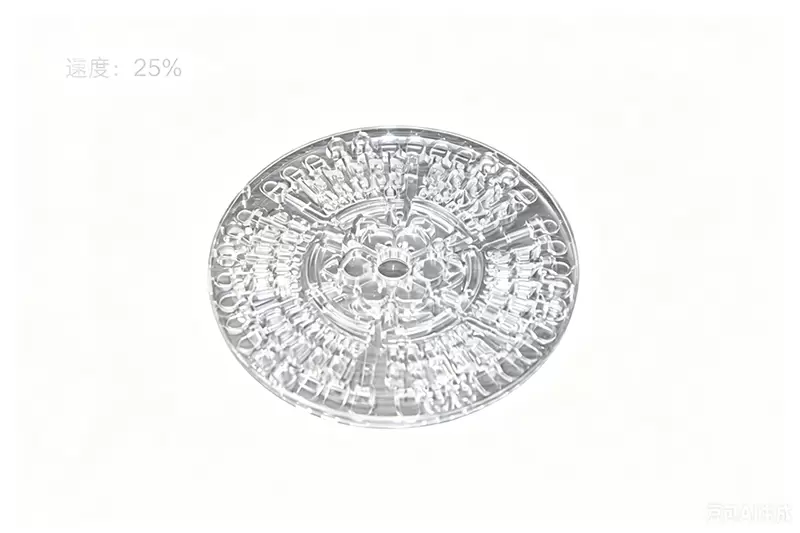
Chip
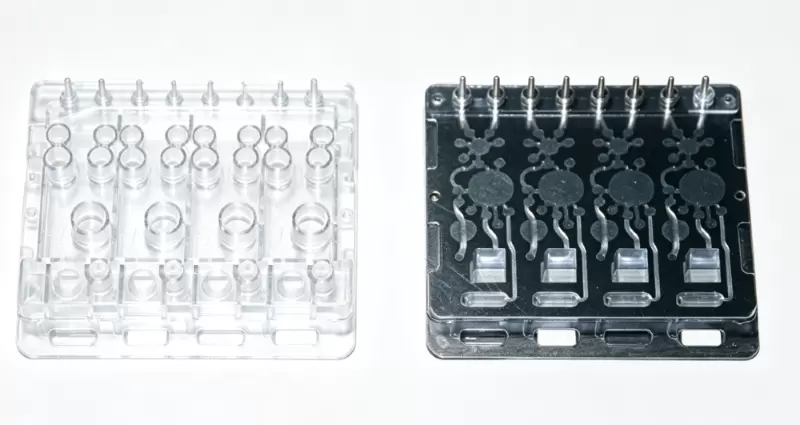
Disk microfluidic chip (LabDisk) is driven by centrifugal force. With disc-shaped structure rotating around the spindle, fluid transfer, metering, lysis, purification, amplification and detection are sequentially controlled by adjusting rotating speed. It supports multi-analyte / multi-sample parallel testing in a single disposable closed chip, enabling sample-in answer-out workflow.
Respiratory multiplex nucleic acid test: Mycoplasma pneumoniae, influenza A/B, RSV, etc. Up to 24-plex parallel amplification on one disc.
Biochemical assay: liver & renal function, blood lipid, cardiac markers, urine biochemistry.
Emergency blood test: electrolytes, inflammatory factors, coagulation assay.
Infectious disease screening: HPV, tuberculosis, blood-borne pathogens (HBV/HCV/HIV). Suitable for primary hospitals, emergency rooms and physical examination centers with compact instruments and no precision external pumps.
Livestock diseases (African swine fever, avian influenza); rapid detection of foodborne pathogens, pesticide residues, mycotoxins and GMO.
Waterborne microbes, environmental toxin detection, field emergency screening for CDC.
On-site DNA extraction & profiling; high-throughput screening, single-cell sample pre-processing, organoid analysis.
Core advantages: Fluid controlled by rotating speed without external pumps; multi-channel parallel detection on single disc; closed structure to prevent aerosol contamination; simple operation for field rapid testing.
Substrate: PC (most common), COC/COP, PMMA; mass production by precision injection molding
Dimension: disc diameter 60–120 mm, thickness 1.5–6 mm; central locating hole to match instrument spindle
Microchannel: width 30–400 μm; depth 20–250 μm; minimum channel 30 μm; aspect ratio 1:1~3:1
Integrated chambers: sample inlet, metering chamber, lysis chamber, magnetic bead capture/wash/elution chamber, amplification reaction chamber, waste chamber; equipped with siphon valve, capillary valve, heat-actuated valve, triggered at different rotating speeds
Fluid actuation: centrifugal force, working rotating speed: 500–6000 rpm; sequential liquid transfer via speed adjustment
Sample loading volume: 50 μL ~ 1 mL (whole blood, swab eluate, urine)
Single reaction chamber volume: nL ~ several μL (typical 1–10 μL); 4~24 independent reaction units per disc for multiplex assay
Metering precision: nL-level accurate quantification, low dead volume
Pre-stored reagents: lyophilized primer/enzyme beads, dry reagents; aluminum blister packs for liquid buffer optional
Targets: single target up to 24-plex multiplex detection (multi-channel fluorescence)
LOD (nucleic acid): 10 ~ 500 copies/mL
Total assay time: 10–40 min (LAMP is faster, PCR takes longer)
Temperature control: isothermal amplification 60–65℃ / PCR thermal cycling 45–95℃; temperature accuracy ±0.3~1℃
Optical readout: fluorescence, UV-Vis colorimetry, absorption spectrum
Fabrication: precision injection molding for mass production; CNC / laser ablation for prototyping; surface roughness Ra≤0.2μm
Surface treatment: hydrophilic / hydrophobic modification, low non-specific adsorption for nucleic acid & protein
Sealing: ultrasonic welding, thermal lamination; leak-proof and aerosol containment
Storage: lyophilized reagent discs can be stored at 2–8℃ or ambient temperature for 6–24 months
Sterilization: EO or gamma irradiation for medical grade
Disk (Centrifugal LabDisk): disc shape, centrifugal driving. Strength: high-throughput parallel multi-channels; Weakness: instrument requires rotating module with relatively complex mechanical structure.
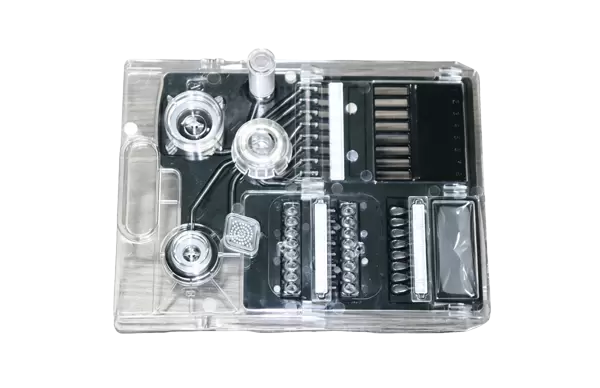
Rectangular Cartridge: rectangular shape, pneumatic/airbag driving. Strength: simpler instrument, integrated valve control for single-sample multi-analyte; Weakness: fewer parallel channels than disc chip.

 English